10+ Moms On Their Screen Time Rules & Reality
Written by Katie Hintz-Zambrano and Royce Branning
Photography by Ivy Lee & More

Courtesy of Ashley Koch
1 / 12

Courtesy of Rio Cortez
2 / 12

Courtesy of Shahidah Al-Amin
3 / 12

Angela Tafoya Photographed by Priscilla Gragg
4 / 12

Courtsey of Kendra Smoot
5 / 12
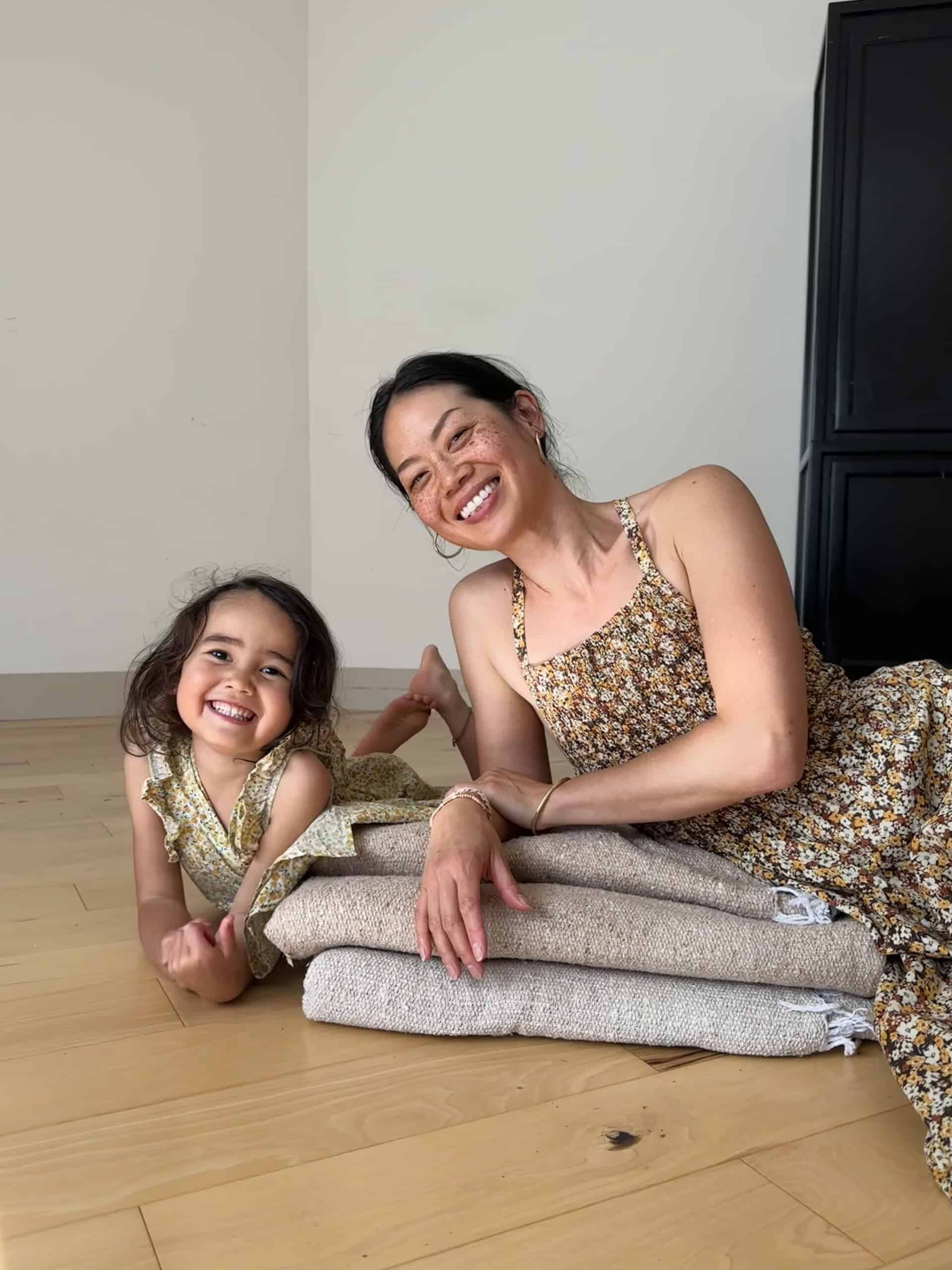
Courtesy of Ivy Lee
6 / 12

Courtesy of Ashley Koch
7 / 12

Cynthia Edorh Photographed by Kathy Lo
8 / 12

Courtesy of Abbi Miller
9 / 12

Courtesy of Subikksha Balaje
10 / 12

Courtesy of Priscilla Gragg
11 / 12

Courtesy of Hannah Suh
12 / 12
Mothers across the country—with children of various ages–sound off on what screen time boundaries (and battles) look like in their homes.
Nine years ago, we asked a group of mothers how they were navigating screen time with their kids. Back then, the conversation felt urgent—but comparatively simple. Tablets were just becoming ubiquitous, social media felt more containable, and the idea of kids carrying the internet in their pockets at all times was still, for many families, on the horizon.
Today, that same question—how are you handling screen time?—lands very differently.
To say we’re parenting in an unprecedented time is hardly an overstatement. Screens are woven into nearly every part of our kids’ lives—from school to socializing—alongside the constant pull of social media, group chats, and now AI. The landscape is shifting fast, and most of us are figuring it out as we go.
For this follow-up—nearly a decade after our original 2017 piece—we spoke with moms across the country, raising kids at every stage: from toddlerhood to the early college years. Some of these mothers also appeared in our original story, offering a rare and honest look at how their rules, boundaries, and perspectives have shifted over time.
What emerges isn’t a definitive guide or a single “right” way forward. Instead, it’s something far more useful: a collective portrait of families feeling their way through a constantly changing landscape—adjusting, rethinking, loosening, tightening, and, above all, paying attention.
This story was also inspired by a recent gathering we hosted in partnership with Clearspace, where we brought together mothers of kids ages 8 to 15 for a day dedicated to unplugging and talking candidly about screen time. It struck us how rare it is for parents to have space to compare notes, to say the quiet parts out loud, or simply to hear, “same.” Because while screens are a daily negotiation in nearly every household, the conversations around them can still feel siloed.
We hope the honest stories shared below help you feel less alone and more inspired as you build your own screen time rules.
Angela Tafoya — mom to Talula, 10, and Alo, 3
"Now that my daughter is 10, I think back to the early days and screen time felt like one of the clearest places to draw a line. Although I was never overly rigid with it, I was conscious of not wanting screens to become the default for entertainment or transitional moments in our home. But I do remember feeling so much guilt around it."
"Right now, with my kids having a larger age gap, with my youngest, our rules really haven’t shifted all that much. We still keep things limited during the week (20 minutes a day tops), with some weekend screen time if it’s family movie night. My daughter doesn’t have free access to a tablet or phone, and we’ll keep it that way for as long as we can. She is also allowed 20 minutes of screen time a day (right now she uses her minutes for Duolingo), and of course it needs to be after homework and household duties."
"Because there is more noise and content available now than ever before, creating boundaries is so important. But for me, now, it feels less about being overly strict and more about being intentional and having open discussions about the content they're watching and the addictive nature of devices."
Find Angela online at @angelatafoya and @noomoon.shop
Kendra Smoot — mom to Stella, 19, Mo, 14, and Truman, 11
"Screen use feels like one of the top three challenges we’re constantly navigating—and redefining—in our family. Most of the time, I feel good about how our kids are learning coping skills and boundaries around living with screens. But when I really sit with it, I sometimes feel sad and wish we were all living in an earlier century. It’s a lot for all of us to manage."
"Our philosophy is to model the behavior we want to see. If there’s an opportunity for human interaction—like standing in line at the grocery store—the phone goes away. We also try not to rely on technology for all of our information. At the same time, we recognize it as a powerful tool for connection: shared playlists, 'ILYSM' texts, photos."
"When a child asks for a new device or app, we wait until they can make a compelling case for why they’re ready for that privilege. If it seems reasonable, we ask them to create a contract that we all agree on and post it somewhere visible. They come up with the rules and the consequences for breaking them, which we can adjust together before signing. There have also been times when we’ve realized it was too soon for a particular child, and we’ve taken something away. Our approach is less about strict rules and more about responding to how things are actually going."
"One thing I love is our charging cupboard. It’s in the living room—just a cabinet outfitted with a charging adapter and a bamboo organizer with slots for phones, iPads, and Chromebooks. Around dinnertime, everything gets tucked in there until the next morning before school. Keeping devices off counters and out of bedrooms really reduces the mindless pickups that happen when they’re always within reach."
"All of this is a work in progress. I know my 19-year-old sleeps with her phone right next to her head in her dorm so she can listen to music all night, and that still stresses me out. I’d love to see more universal norms around phone use. My dream app would require you to complete a few learning tasks—like solving math problems or practicing verb conjugations in another language—before unlocking your phone. There’s so much potential in technology that still feels underused."
Find Kendra online at kendrasmoot.com and @kendrasmoot
“Our philosophy is to model the behavior we want to see. If there’s an opportunity for human interaction—like standing in line at the grocery store—the phone goes away.”
Cynthia Edorh — mom to Chloe, 12
"My daughter started asking for a phone early on. The pressure was on as many of her classmates were already getting phones as early as age 9! I promised her a phone as a reward the day she achieved a perfect report card. Thinking it would buy me time, years! Little did I know that five months later, at afterschool pickup, I would see her skipping down the hall waving her report card with a big smile. She had received a perfect report card. What to do? I had to keep my word."
"Here's where we stand a few years later: In New York, thankfully, students are required by law to turn off and lock their devices via magnetic pouches during the school day. At home, no phones are allowed during meals, this applies to everyone, kids and adults. No phones at sleepovers or playdates where a parent is reachable for emergencies. Screen time is limited to one hour maximum per day. Social media is accessible on my phone only on weekends and must be supervised."
"Some of the benefits this phone provides include increased safety, peace of mind, and an easier way to navigate unexpected schedule shifts and emergencies; but what I would do to raise my daughter in the 80s and 90s! Making a plan then was an exercise in intentionality and commitment because once you left your house, you were essentially unreachable. You called a friend's house and often had to speak with their parents first. You made a plan to meet a friend for dinner downtown on Friday at 6pm. Without confirming in real time via text, without a calendar reminder, and without needing a phone with a map giving you the fastest route and estimated time of arrival. You planned, you showed up and waited, or you got lost and eventually found your way. Where the magic happened!"
Find Cynthia online at @cynthiaedorh
Shahidah Al-Amin — mom to Saniyah, 17, Khayri, 15, Aziz, 10, Nasir, 8, and Yara 2
"If you asked me 9 years ago, I believed screen time was mostly about what my children watched. Today, I see it more holistically. My biggest concern isn’t just content, it’s how constant access to screens can shape attention, reduce creativity, and quietly replace presence, conversation, and curiosity. Even the most educational content, when consumed passively, can limit a child’s ability to think independently or engage deeply with the world around them."
"In our home, we try to stay away from strict control and lead with intentional rhythm. Screens have a place, but they aren’t the default, they come after reading, movement, responsibilities, and real-life interaction. We also talk openly about what they’re consuming so they learn awareness, not just compliance."
"As for me, I’ve had to model that same discipline by being mindful of my own screen habits, especially with my toddler around. Putting my phone down, being fully present, and choosing connection over convenience. I don’t believe in shame around screen use, but I do believe in recognizing the trade-offs and leading our families with that awareness. This is part of the work we do as parents."
Find Shahidah online at @shahidah.alamin

Hannah Suh — mom to Leo, 12, Eleanor, 12, and Logan, 8
"I hold a lot of resentment and a sense of loss when it comes to screens and our kids today. I credit a lot of who I am today to the wonderfully formative experiences I had on the internet of the 1990s and early 2000s. This intensely siloed, algorithmic, and social media-driven internet of today is not the one I had to navigate growing up, but it is the internet our children are inheriting and for that I am apologetic to them, and frustrated for myself as the one now responsible for acting as the guardrail to this new landscape."
"After pinballing between various methods of screen time regulation, what we’ve landed on is just completely limiting most screen time during the weekdays and then allowing looser, free access to computers, gaming devices, or iPads on the weekends. Our goal has been to try and find some kind of balance between removing screens as an option most days while showcasing the ways screens can be fun or entertaining or a creative outlet or educational source at other times. We’re taking a 'cookies are a sometimes food' approach and hoping this level of regulation is striking a decent balance in the long run."
Find Hannah online at @hannahsuhphoto
Priscilla Gragg — mom to Naya, 15, and Bia, 12
"My biggest concern is that they’re not getting bored enough—I really believe boredom is what feeds creativity. And my biggest challenge has been social pressure. Many of their friends had devices as young as 8 or 9 and early access to apps like TikTok, so it hasn’t always been easy to hold our ground and delay that exposure."
"I have a 15-year-old and a 12-year-old, and our approach has been not to micromanage their device usage. Instead, we pay attention to the bigger picture: how they’re doing in school, how much they’re moving their bodies, how they’re socializing in real life, and whether they’re engaged and present in our family life. Both of them got their iPhones when they started middle school and began taking the bus, which felt like an important way for us to stay connected as busy parents. For them, it’s also a big part of how they maintain friendships across different groups—school, theater, capoeira, cousins. The reality is that so much of their social world happens through texting that you can easily feel out of the loop if you’re not part of it."
"When my older daughter started asking for social media, she used the classic 'but all my friends have it,' and a friend once gave me a great response: 'Your friends all sound amazing…which one would you like to go live with?' That usually earned me an eye-roll, a walk-off, and bought me a few quiet weeks. She just got her first Instagram account as she’s about to turn 15—it was partly a birthday gift after years of asking. We had many open conversations: she talked about trust and learning from her own mistakes, while we emphasized protecting her time and continuing to invest in things she loves like art, drawing, and painting. In the end, we said yes—with awareness. She has a private account, barely posts (apparently that’s not the cool thing), mostly uses Stories, and it’s actually created a sweet new way for us to connect—she’ll send me recipes or puppy videos."
"Another important part of our approach is trust and privacy. I see their devices almost like their diaries—and I know that at that age, I wouldn’t have wanted my parents reading mine. So I don’t have their phone passwords, but they know that if I ever feel something is off, they’re expected to open their phones for me. It’s a balance between trust and accountability. My younger daughter doesn’t have social media and hasn’t really asked for it, but she recently told me she felt like she was getting bored and defaulting to her phone. We looked at her screen time together—how many hours she was using it and how often she was picking it up—and she was genuinely surprised. From there, she chose to set her own limits on things like Pinterest, Toca Boca, and texting, which felt much more powerful than me enforcing it. Overall, our philosophy is to stay involved, keep communication open, and guide them—without trying to control every detail."
Find Priscilla online at priscillagragg.com, @prigragg, and @casastudiophoto
Rio Cortez — mom to Santi, 7, and Mars, 3 months
"We've never adhered to any particular philosophy around screen time (though perhaps we should have). We are definitely a Type B household when it comes to rules. For Santi, we managed to more or less avoid screens during her first year of life. And then the pandemic hit and at its peak we took a cross-country drive during which we critically relied on screen time to tote our then 18-month-old across multiple state lines in the car. After that, I feel like the digital floodgates sort of opened. Screens became a thing we used to cope with difficult moments in parenting while multitasking during the pandemic. And I've felt a little bit of guilt about that."
"But now that Santi is 7 years old, I'd say we try to just be present and watch the screen with her. If she has screen time, we share it. We process it together, we react together, we laugh together at whatever it is she wants to watch. It hasn't made screen time too off-limits or precious, it's accessible to her, and in that way I think a little less appealing (which we love). And watching TV this way sometimes even gives us an opportunity to connect and can even be a springboard for larger discussions about the world. Lately she's been watching the full stage production of Hamilton, which is kind of delightful. She's also into animal documentaries and recently she introduced us to this great animated show called Craig of the Creek."
"When it comes to the baby, I think it will be interesting because we will be navigating the tastes and preferences of two children with a significant age gap. But for now, Mars is content to stare at the ceiling fan."
Find Rio online at riocortez.com and @ohreallyrio
Ashley Koch — mom to Zoey, 14, and Sloan, 12
"These days, I’m the mother of two girls, ages 14 and 12, and it’s been interesting to see how our relationship with screens has evolved. What stands out most is that we have two very different children who require different boundaries. We’re mindful of the impact screens can have and continue to adjust as needed. My husband and I often talk about the reality that devices are here to stay and how much time our kids will inevitably spend on them in the course of their lives. He doesn’t use social media and has a very healthy relationship with his phone. I haven’t always had that same balance, which is why I took a six-year break from social media and have only recently started exploring how it might fit into my life in a positive way. Our approach has become meeting each child where they are, while setting boundaries that protect their mental health. Our girls know my priority is raising daughters with a strong sense of self and self-esteem, and they know that if that starts to slip, we will adjust their access to devices as necessary."
"Our oldest is very mature, social, and grounded, so we’ve allowed her screen use to grow alongside her responsibility. When she spent six weeks away at ballet training roaming a college town in the summer after sixth grade, we got her a phone for safety. She started without social media, and over time, she’s made thoughtful, even presentation-style cases for apps like Snapchat and TikTok. We eventually said yes to Snapchat because it was affecting her social life, and we’re still testing TikTok with about 15 minutes a day. Her phone stays out of her bedroom at night. She does struggle to put her phone down at times, and we see it as our role to help manage that while her brain is still developing. She’s generally receptive, and her involvement in sports naturally limits screen time. On quieter days, we have her plug her phone in for a few hours so she can experience being bored and screen-free. We talk often as a family about how addictive these devices can be, and we’re always open to adjusting our approach. Our house is also known for having kids plug their phones in overnight during sleepovers, and we love the weeks our girls spend at summer sleep away camp, completely device-free."
"Our younger daughter, who is wrapping up sixth grade, is very different and not ready for screens in the same way. The iPad was dysregulating for her, so now it’s only used for long travel. She’s much happier without it. She occasionally uses a Nintendo Switch with family, but it’s not part of her daily life. We don’t allow highly addictive, dopamine-driven games. She enjoys shows and movies, but her life is full with school, friends, and sports, which creates a natural balance. At this point, we don’t plan to give her a phone until high school. She has an Apple Watch to communicate, and interestingly, she doesn’t seem to want a phone yet."
Find Ashley online at AshleyKNutrition.com
“My biggest concern isn’t just content—it’s how constant access to screens can shape attention, reduce creativity, and quietly replace presence, conversation, and curiosity.”
Ivy Lee — mom to Adelise, 5
"With my 5-year-old daughter, I’ve been intentional about not exposing her to media or screens, and I’m hoping to avoid it for as long as possible. We choose to not have TVs or tablets in our home. Young children have remarkable abilities in perceiving and engaging with the world around them. There is so much connection, learning, and creativity that comes when kids are tuning into all five senses. I’ve noticed that when my daughter uses her hands to feel and experience, it forms meaning and activates the brain in expanded ways. And through deepening in presence and awareness, she has the opportunity to develop her intuitive and extrasensory abilities."
"The amazing thing when kids aren’t being entertained by media is that they find ways to entertain themselves. This is where creativity and genius really shines. Our family is fortunate to have a garden and we spend a lot of time in nature. My daughter can identify more plants, flowers, and leaves than most adults can. She’s curious about what happens after a butterfly dies, problem solving to prevent birds from eating the small sprouting sunflowers, and saving seeds to grow more of her favorite watermelon next season. I think because she isn’t used to consuming programmed inputs, she finds the world around her fascinating and comes up with brilliant ideas. I love seeing how her mind lights up and how her heart finds ways to connect to what’s around her."
Find Ivy online at luminaewellness.com and @luminaewellness.
Abbi Miller — mom to Wilhelmina, 6
"The parenting paradox of screens makes me think of the quote, 'Life is what happens when you're busy making other plans.' My other plans are my kiddo hanging screen-free whilst playing with wooden toys, decked out in organic linen. But what does my kiddo want? Neon polyester and Gabby's Dollhouse. Parenthood is such a lesson in surrender. My kiddo is her own human, with her own desires (read: polyester & Gabby), while I have other plans (linen & educational podcasts)."
"We wanted to wait to introduce shows until she was 5, but when I got Covid for the first time when she was 3 1/2, it took me down so badly that I literally handed her my laptop and said 'This is called Mr. Rogers Neighborhood!' and laid in bed with a fever while Fred babysat my kiddo."
"Screens are a gift to parenting. They are also incredibly problematic to developing brains. I have the capacity to hold the duality."
"After her intro to Mr Rogers, she asked for shows and we deliberated on what to do. Ultimately we've found that total restriction feels nuts and honestly more stressful for us. These days, since she's 6, we have a few simple boundaries and rituals:
-We don't own a TV, laptops only.
-FaceTime doesn't count as screen time, since her grandparents live in another state/country.
-We allow a show or two on the weekends or a family movie night once a month.
-Online yoga doesn't count as screens, since she actually does the yoga! (love you Jamie)
-She gets to go ham on airplanes with unlimited screen time, which is a special treat and hasn't seemed to backfire!
"These all feel positive and honestly she doesn't ask for screens much. She really loves a good podcast (We love ABC Adventures and Bonigdoo), and I feel we've struck a balance!"
Find Abbi online at workwomb.com and @workwomb
Subikksha Balaje — mom to Ranav, 5, and Veera, 3
"Screens aren't really a reward or a punishment in our house, they just haven't been part of the routine yet. Ranav (5) and Veera (3) haven't asked for a device and probably won't for a few more years? Hopefully. We were actually worried about this after our recent travels and even practiced what we would say if they started asking. We travelled to Thailand and India last year and yes, those flights are LONG. They watched many shows on the flight. But once we landed, it was right back to word games for the car rides."
"The only real 'rule' is no screens or devices at mealtimes, and honestly that rule is mostly for the grownups at the table. We get fewer hours together since they started school, so it's less about fear of screens and more about protecting the moments where we're together."
Find Subikksha online at goldstoriesjewelry.com, @subikksha, and @goldstories
Share this story