Whether by choice or circumstance, single-child families are becoming more common. However, stereotypes still persist. Jacqueline Stein, a proudly one-and-done mom to a precious son, is hoping to change this with Only Hearts Club, a support system for mothers of only children. (Follow them on Instagram here) Below, Jacqueline shares her personal story, as she advocates for building community with others who are in a similar boat raising an only (not lonely) child.
Years ago, I sat down with my mother and asked her why she never pushed me harder as a child.
Her answer was simple, and it has carried me through more decisions than I can count: “Because you always knew what you wanted. It didn’t matter what I said. You were going to do it your way.”
Today, as the mother of an only child, that couldn’t ring more true.
Motherhood is something I chose very intentionally, but not something I dreamed about as a little girl. I don’t have distinct memories of playing house or imagining the day I’d have children of my own. I spent my twenties largely single, studying, working, and living in different parts of the world. Too many adventures to count. Some heartbreak. Plenty of life lessons. But not a long-term partner—or a child—in sight.
In my early thirties, slightly more settled and calling Toronto home, I took a trip to Havana with my girlfriends and met my now-husband. We married, he moved to Canada, and we began talking about expanding our family. Then the pandemic hit. In April 2020, I joked that with the world seemingly falling apart, a Covid baby was absolutely not in the cards for this married, 34-year-old, currently childless woman. By August, I was pregnant with my son.
My pregnancy was uncomplicated, my labour and delivery straightforward, and my recovery minimal. My son arrived easy-going and content. By every measure, the conditions were right for more. And yet I knew—from the very beginning—that I wouldn’t be having another. Every first would also be a last for our family. That knowledge didn’t arrive as grief. It arrived as certainty. And I’ve never once questioned it.
There is a particular kind of dismissiveness that follows moms of one. It sounds like: just one? That must be easy. As though the number of children you have determines the weight of the work. Motherhood is not easy with one. Your time is no longer your own. You are your child’s primary playmate. There are financial obligations, logistics to arrange, a social life to actively nurture—for them and for yourself. On some days, one can be a lot. The difference is that nobody gives you permission to say so, because you just have one.
I’ve given myself that permission. And I’ve tried to give it to every woman who needs it.
For much of my career, my work has centered on women—in international development, across borders and cultures. I’ve sat with women in Africa, Asia, and here at home in Canada, listening to what their lives actually look like and what they need. The circumstances are always different. The need for space, voice, and community never is. Building something for women was never a leap for me. It was the most natural thing I’ve ever done.
What began as a local Facebook group for Toronto moms of only children, Only Hearts Club eventually grew into a global Instagram community with women from every corner of the world. I built it because I couldn’t find it. I was looking for a space that was centered not on the child, not on the family structure, but on the woman—the mother—navigating this particular life with honesty and without apology. When that space didn’t exist, I decided to create it.
Because here’s what I’ve learned from the women who arrive at Only Hearts Club: the experience of having one child—whether by choice, circumstance, or something in between—can be an isolating one. Not because the life itself is lonely, but because the conversation around it so often is. Women come to my community having fielded the same questions, absorbed the same assumptions, and carried the same quiet weight of feeling like their family needs a footnote.
What they’re looking for isn’t someone to validate their path. What they’re looking for is connection. Community. The relief of being in a room—even a virtual one—where nobody asks when you’re having another, where their family is not a consolation prize or a work in progress, where they are simply seen.
That is what community does. And that is why it matters. Only Hearts Club is, in many ways, the most personal expression of work I’ve always believed in.
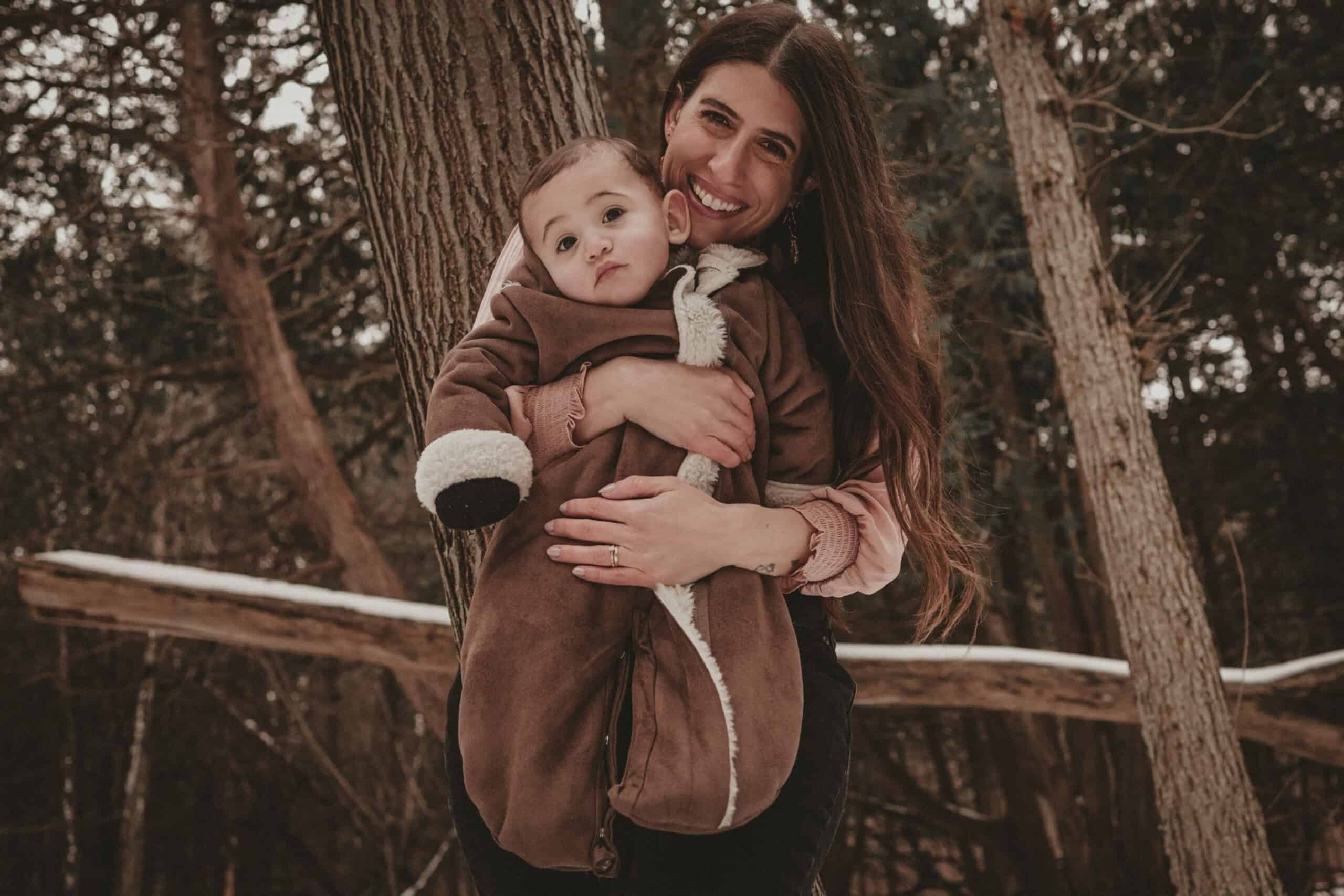
My husband is also an only child. I’ve watched, firsthand, the bond he has with his parents. It’s close, uncomplicated, and always present. In many ways, it’s enviable. And I see it in our own family too. Not in grand gestures, but in the small, ordinary moments that are entirely ours.
Sunday afternoons at the Blue Jays game, my husband encouraging our son to walk down to the bullpen and ask a warming pitcher for a ball—teaching him to be bold because he knows we’re always behind him. My son at the finish line of one of my half marathons, cheering me on, witnessing his mother do something hard and finish it. Weekend mornings in the kitchen, his enthusiasm for baking completely undimmed by the mess he makes.
One child means we are not pulled in multiple directions. We move through life largely as a unit—or, when we don’t, one of us can step away more easily because there is one child, not multiple, holding the other’s attention. I didn’t anticipate how strong that bond would feel. Our son wants to be with us. Not because he has to be. Because he knows we’re entirely on his team.
The most persistent myths about only children are that they are selfish and socially awkward. That, without siblings, they never learn to share, to compromise, or to connect with others.
I am the elder of two. And I can say, with complete honesty, that I am more possessive of my things than any only child I have ever known. As for socially awkward—my son is one of the most outgoing, vivacious people I know. He has made friends wherever he goes, from his earliest days. The research reflects this too. Study after study finds no meaningful difference in the social development of only children compared to those with siblings. What determines a child’s capacity for generosity, empathy, and connection is not the number of people in their home—it is the quality of what happens inside it.
A sibling is not a guaranteed friend. And the absence of one is not a guaranteed loneliness. It all starts in the home.
Around the world, one-child families are on the rise. The reasons are as varied as the women living them—economics, health, age, circumstance, or simply a clear and considered decision. I’ve chosen to be vocal about mine not because my path is the right one for everyone, but because the silence around it has allowed the stigma to grow unchallenged.
Every week, women find my community looking for the same thing I was looking for when I built it—a space where this life is not something to be explained or defended, but simply lived.
My mother was right. I always knew what I wanted.
This is me, saying it out loud—for every woman who needs to hear it.
Find out more by visiting theonlyhearts.com and @theonlyhearts on Instagram.
Share this story