Baby Nova: A Story of Love, Loss, and Endurance
Written by Tami Busia
October is Pregnancy and Infant Loss Awareness Month—a time to honor the babies gone too soon and the parents who carry their memory. In this deeply moving essay, Bay Area–based mom Tami Busia shares the story of her daughter Nova—from her water breaking at 19 weeks, to 8 weeks spent on bed rest in the hospital, experiencing life in the NICU, and the ways she found strength, creativity, and community through it all.
I had always dreamed of having a big family, but it seemed that my body was working against me. In 2017 I had my first miscarriage at 9 weeks. After a stellar ultrasound two days later, while getting ready for work I began to bleed and passed out the baby in the ER.
In 2018, I had our beautiful daughter, Zella, in what I heard described as a textbook pregnancy and birth. She was born after 36 hours of unmedicated labor. Watching her grow up and be this incredibly bright, sweet 7-year-old has been the light of our lives. We decided after some time that we would like to continue to add to our family.
In 2021, I had my second miscarriage at almost 8 weeks. My HCG numbers were not doubling and I had a D&C in the ER with only local anesthesia.
It then took 2 1/2 years to fall pregnant again. I had honestly started to give up. Every month we tried and every month it was a negative test. I looked for any signs and did testing to see if it was something happening with me medically. My OBGYN tried everything under the sun before suggesting it was time to see a fertility specialist. With that being a huge expense not covered by our insurance, I had given up hope. When we moved in early December 2024, I gave away all the baby things I was saving.
By late December 2024, I found a pregnancy test while packing and said, “Why not?” I took it kind of in a sad joke—saying to myself, “It’s going to be negative, like all the rest.” But to my surprise, it wasn’t.
With my previous losses I felt cautiously optimistic. Unsure if I should celebrate or simply wait. This being my 4th pregnancy, I understood the first trimester pretty well with HG and had a routine down to a science. From doggy bags on hand for spontaneous “morning sickness” (which also included extreme bladder pressure) to having an abundance of snacks ready to-go to ward off the nausea. I even made sure, while traveling to and from work, to sit in the same direction as the train.
Despite constant vomiting and trips to the hospital for IV fluids, everything was going well. I had requested more frequent doctor appointments to assure myself about the progression of the pregnancy. We ran all the testing and everything came back beautiful. In that testing we learned we were pregnant with another girl. I felt her kicking and fluttering pretty early in the pregnancy around 10-12 weeks. It was always a surreal feeling to feel the life growing inside you move, especially because this baby girl already had so much energy.
After going into my second trimester, I began to take a deep breath. The percentage of miscarriage past 14 weeks was significantly lower and our appointments were measured correctly. The baby even posed for ultrasound photos with perfect profile pictures. Every Thursday was a new week of pregnancy. Our eldest would sit with me every Thursday morning to learn the size of the baby and how she was growing this week. Zella would measure my belly growth while gathering books and toys that she wanted to pass down to her baby sister.
On Thursday April 10, 2025, after a long day at work and a sorority event that followed in San Francisco, I got home with an extreme urge to use the bathroom. I had been struggling with constipation this pregnancy but was mostly successful in the end. While attempting to use the bathroom my whole world came crashing down.
My water broke. The pop was so loud that I was stunned at first. Then I screamed. At 19 weeks my water broke and all the amniotic fluid was rushing down my legs and onto the floor. I rushed to our local ER where they did an ultrasound showing our baby was still okay. The hospital was not equipped for Labor and Delivery and I needed to be transferred to a different hospital, but I was low on the ambulance priority list. For hours I sat in the ER in absolute disarray and unaware of the next steps. After the 3rd hour we requested for me to be discharged so my husband could drive us to the new hospital.
When I arrived at the new hospital’s Labor and Delivery department, it was confirmed that my amniotic sac had ruptured and there was no measurable fluid. Something they called premature rupture of membranes (PPROM). They performed an ultrasound in triage to check on the status of our daughter. She was laying back sucking her thumb and playing with her toes. The sound of her strong heartbeat filled the room. It was the most beautiful sound in the most terrifying moment.
We were informed that when the bag ruptures my body would begin labor in the next 24-48 hours. And every doctor—who had seen hundreds of preterm labor cases—had the saddest expressions when discussing what would be taking place. I was given the option to terminate the pregnancy or continue on.
At this moment I learned I had to stick with the facts. Our daughter’s heart was beating, she was not in distress, I was not in labor, and I wasn’t dealing with an infection. I asked questions to know what the best-case scenario would be and the worst. Then I lived in the current facts. And I had to remain calm.
A week had passed and everything was still the same. Which led us to hospital protocols. Pregnancy viability begins at 23 weeks at this hospital. If choosing to continue the pregnancy after a PPROM, the patient is discharged and told to come back at 23 weeks. But with extreme risks attached. We were told because the sac was ruptured and open the biggest concern was infection. An infection that could rapidly spread and cause sepsis. Although I wasn’t hemorrhaging or spontaneously beginning to bleed, I was told I would be discharged and to come back at any sign of change, but that just didn’t sit right with me. Going home without being monitored seemed dangerous to me, and I asked to stay.
The doctors informed me, again, that it was not a decision that they were making but simply hospital protocol. I asked, “Will you all physically drag me out of here” if I refused to leave? My request to stay resulted in a week of meeting with hospital leaders, social workers, the chaplain, my OBGYN, and ended in an ethics committee meeting. My OBGYN and I have a strong rapport and an honest, candid relationship. Sitting with an open bag was described as sitting on a ticking time bomb with a lot of concern around my ability to come out the other side, let alone both of us.
Every day our baby girl showed us not to count her out. She was determined for us to meet. If she was fighting, I was fighting. I still had a 7-year-old daughter to make it home to. Balancing fighting for both my girls became a strong duality for the next 4 months.
There were a number of serious concerns around our daughter’s development in the womb without amniotic fluid. From growth restriction, to physical deformities. But the one that was at the top of mind for everyone was lung development. The fluid allows for babies to practice breathing, strengthening their lung tissue and allowing them to grow. In our case, because there was absolutely no measurable fluid, the chances of her lungs being undeveloped were extremely high including a potential risk and reality that the lunsg just might not work. Even with technology as advanced as it is today, this was one bit of information we would not receive until she was born. We were living in a truly unknown territory.
With fear of contracting any type of virus or infection, I stayed in my hospital room, only leaving for an ultrasound or if I needed to move rooms due to hospital construction. For 6 weeks I remained focused on those facts and our agreed-upon deal breakers. The facts remained that our daughter’s heart was strong, she was not in distress, and I did not have an infection. I segmented each day into quarters allowing me to fill the pockets of time with an activity.
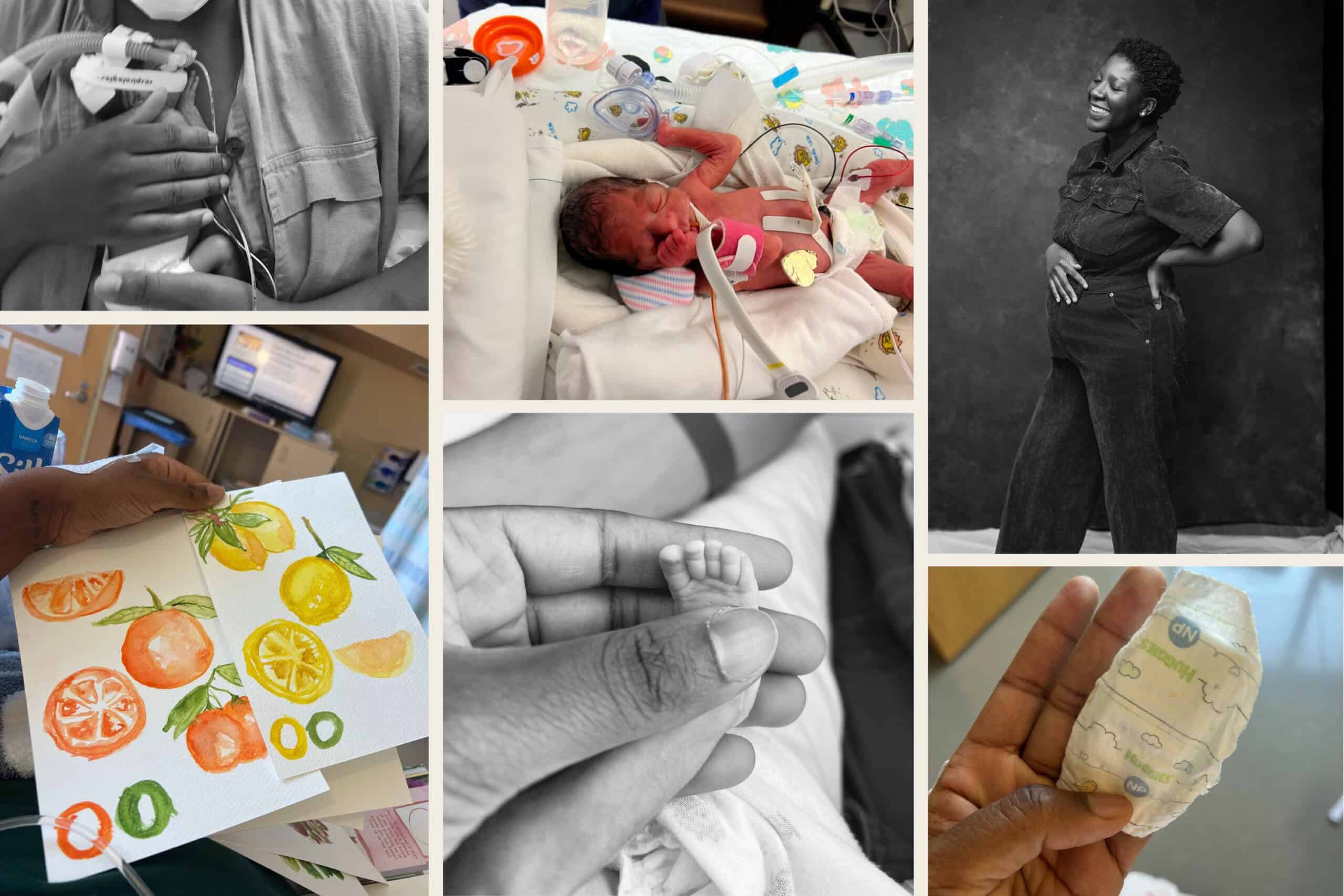
Being married to an incredible artist, I thought I would give his profession a shot through paint-by-numbers kits. Matching the colors with the numbers resulting in a completed painting to hang in my room was extremely therapeutic. As an avid reader, I thought I would be able to fill time going through waist-height stacks of books on my TBR list. But I just couldn’t get my mind to settle down. Painting, crafts, and puzzles allowed me to escape the endless worry about if we’re going to meet our daughter and if I would be leaving to see my home again.
When I saw MOTHER hosted an incredible watercolor painting event for the author of The Watercolor Feast, I ordered the book and my husband bought me watercolors and I learned a new skill. One that would be a significant part of this journey. The hospital’s Maternal Fetal Health Specialist is an incredible watercolor artist and baker. We would talk for over an hour about my pregnancy and art, books and food. Our time together was special and a beautiful part of this journey.
Throughout my time in the hospital, I met the most incredible people. Healthcare workers showed endless amounts of love with how attentive, caring, positive, and uplifting they were. Because there were very hard days that kept me up in the early hours of the morning in knee-shaking fear or bone-deep sadness about how my body had not done what we are told all our lives it was supposed to do. It’s almost as if they could sense these moments because someone would always visit and bring with them lightness and warmth changing the energy of the day. They sat with me through the tears and fears. Antonio, who ordered everyone meals, was also an artist. He painted an incredible picture and made sure I had extra potatoes with my breakfast and cookies for Zella. It was these acts of kindness that made each day brighter.
My family and time with my husband and daughter was my constant reminder that this fight was possible. Besides decorating my room, one of the things that made my stay comfortable was not having to wear the hospital gown. I recommend anyone in this position to do the same. It seems like a small detail, but it was a huge deal to me. It was one less reminder of where I was and everything at risk. My family made sure I had comfortable nightgowns to choose from and and our incredible Alameda mom community supplied a long lasting supply of DoorDash gift cards to order food that my husband and eldest would often deliver. With those gift cards I was able to have meals with my daughter and husband who would visit after school. When asked how I made it through, never leaving my room, I couldn’t have done it without all of them. From daily check-ins from a dear friend who had also experienced this, to Pokémon deep dives with my 7-year-old and husband. Working for a professional women’s soccer team, the company understood and supported my family tremendously during this time. One of the founders even dropped off food to my family so that my husband could have the night off of dinner duty. HR communicated with me regularly and my team covered my work load. I looked up and my community had shown up.
Antepatrum is a difficult section of the hospital to be in, due to it also being in the postpartum wing of the hospital. I would hear beautiful baby cries at all hours of the day and hope and pray I would get to hear my daughter cry. At the hospital I was at, when a baby is born and the mother is headed to postpartum, they play “Lullaby and Goodnight.” I would sing it to my baby girl in hopes that we would also get our lullaby. Hospitals are filled with codes—and hearing codes is terrifying. Especially as we learn more about Black maternal health. There are pros and cons to having that knowledge as a Black woman. The strength is in knowing hospitals recognize and are making the necessary changes for Black mothers—and it’s also terrifying as a pregnant Black mother in an extremely high-risk pregnancy to constantly hear the statistics. To combat that fear, I asked questions. Every question that I thought of, no matter how crazy or how small, I asked the question. To gain a piece of mind, I asked a lot of questions and went through many scenarios. I wanted to mentally prepare.
At 25 weeks, the hospital started to monitor our daughter more and were beginning to see some changes in her behavior. Her variability was changing. I would drink juice to wake her up. When that method began to become less effective, a decision needed to be made. We had a delicate balance between needing her to stay inside and grow and knowing when to proceed with the C-section. During our 20-week anatomy scan, it was found that I had a complete placenta previa, and no longer had an option to give birth vaginally.
Once we reached 23 weeks, the baby was viable and I received the first round of steroids for her lung development. We were then prepared for what we started to see at 25 weeks. I was moved to the Labor and Delivery ward and proceeded to have the most physically challenging 5 days of my life. As we danced the line between continuing the pregnancy and delivery, I was going between a no-food restriction, a clear liquid diet, and being able to eat. I was placed on magnesium, for her neuro protection, on and off for 5 days, and given another round of steroids for her lungs. I was so hungry and in physical pain due to the bed position I needed to be in to prevent her drops in heart rate.
I was in a very uncomfortable Labor and Delivery bed for the first 2 days days until my antepartum night nurse, Rhonda, came in and said absolutely not. They switched me to a postpartum bed which was drastically more comfortable. During these days, I cried hard and worried I was going to give up. Everything felt unattainable. But then I would hear her heartbeat and remind myself if she’s fighting, I’m fighting. Contractions started coming more frequently, which was a new development and signs that an infection might have started but they were not consistent enough to be considered active labor. A bedside biophysical ultrasound test was performed in which she needed to show the following: big movement, practice breathing for 30 seconds, strong heart beat, and the flexing of limbs. It was on her third bedside ultrasound on May 27, 2025, at 11:30pm, that my doctor looked at me and said “you see what I see” and I said yes. Our baby girl was beginning to show sides of lack of movement. It was time to move. She called it C-30, a C section in 30 minutes.
As the nurses who had been on this journey with us filled our room to prep, I put on Cowboy Carter and headed to meet our baby girl. My husband was at home taking care of our eldest and thought I would have to deliver alone. Before beginning the procedure, they let me know he was getting ready to come in. He had met his mother in the parking lot who took home our eldest so that he could be with us just in time.
Nova Lynn Akua Metoyer Mullon was born on May 28, 2025, at 12:32 a.m. at 1lb 9.8oz via classical C-section. She had the most beautiful cry two parents could ever hear. Apgar Score 6/8. We got our lullaby!
Goal one was accomplished and thus began our journey to the NICU. Our relationship with NICU was a little different than many expect because we fought to get there. The NICU was our second of three goals for our family. In hindsight, now my relationship with the NICU is both one of gratitude and anger.
Nova’s lungs worked. Shocking everyone who had heard our journey. We were told that the doctors were absolutely prepared for the worse. She defied the odds and soared past their expectations. Nova was placed on a CPAP, which is the lowest oxygen-need device. And for most of her NICU stay she remained at a percentage of 25-30% oxygen. She could do nose breaks and breathing on her own for minutes at a time. She fell in love with her pacifier. At 2 days old, could hold and suck it all on her own.
The moment I returned to postpartum from my C-section, I began pumping. I would bring milk swabs, which they would let her suck on while she had nose breaks from the CPAP mask. Those were her lollipops that made her eyes light up with excitement, followed by a happy dance. The energy she had was out of this world. Always moving and swatting people away. Crying big little 1lb cries when the diaper was wet or full. She was known on the floor as the feisty fighter.
Being in a different part of the hospital for the first 4 days of her life was hard. I was recovering from a classical C-section and was extremely swollen from the days of magnesium fluid build up. I’d walk down the hall through the doors to NICU to talk with her and pump, while also spending time with our 7-year-old who wasn’t allowed to see her sister in person and allowing my husband to spend time with Nova.
When we first met her, the team of nurses and doctors we were in awe. They were attentive and we began to select her primary care nurses—3 of whom showed her a love any parent would want to see someone give their child.
The day I was being discharged was also my first time getting to hold Nova skin-to-skin. Her nurse Stephanie was determined to make this happen for us. Nova and I snuggled for 2 hours before my body reminded me that it just had major surgery and could not hold a position for much longer. To hold her in my arms felt like a miracle had come true.
What I was not prepared for being discharged and leaving the hospital after 8 weeks and leaving our Nova in the NICU.
My first day home was absolutely terrifying. Nova was 30 minutes away and I was pumping every 3 hours no matter the time of day. Zella was born vaginally. This was my first C-section, and I was in pain and unable to take the time to heal. All the emotions hit at once. I stood in my kitchen sobbing, feeling like so many balls were in the air and I did not know which to catch first. As the birthing parent there are many emotions that I was carrying from fear of losing my daughter to absolute shame that my body had both allowed us to survive and failed to have a successful pregnancy. There was absolutely no time to process any of that! My daughters were my priority. We structured our days into two parts: mornings with Nova and afternoons with Zella.
Nova’s primary team of nurses were amazing. I grew close with them as I learned all the ins and outs of the NICU. Cassie and Stephanie were with her the most, as they quickly learned her personality and created their care based solely around Nova. We called every 2-3 hours to receive updates when we were not bedside, but we were there every day. We were there changing her diapers and doing skin-to-skin. Talking with her and doing hand hugs when she cried. An unswaddled Nova Lynn was not to be unobserved, she was known for pulling out her GI tube or pulling off her CPAP mask. One of her primary nurses even crocheted Nova an adorable octopus. And made one for her big sister to have at home. I once told a nurse “ummm she has her hands free, and she said it’s okay.” I followed with “ummm it’s probably not the best idea, she will pull things off.” A nurse was back in two minutes later because Nova had indeed pulled her mask off. Later the nurse came to me and said, “you did say that would happen” and that I knew my daughter. I did know her. It was a gift to know her.
By week 2, we started to get into a groove and let our guard down a bit, but kept our routine. The routine allowed my mind to balance and understand the situation. When home from the NICU with Zella, we would all watercolor and draw together as a family, pictures to hang in Nova’s room.
Four days before her 3rd week, I began to see some changes in her energy and noticed she had more mucus and secretions. I asked, but was told this is a rollercoaster filled with ups and downs and what we were seeing was normal. I proceeded to ask about what I was seeing the next day, but was met with the same response. The dismissive behavior of staff (who were not her primary care) had started to become a common occurrence, which angered me. From dismissing Nova’s dislike of common positions to lack of consistency of both nurses and a new set of doctor’s care.
Then I received the call at 1:30 a.m. that at midnight Nova had coded for the first time and needed to be resuscitated, but had recovered and was back on a CPAP at 30%. Doctors informed me that she had scarring on her lungs and was having more apnea episodes than before. It was in this conversation I learned that I had had an infected placenta when she was born, which led to the changes we were seeing in the womb. I was stunned because I had presented very little of the symptoms that I was told to look out for. The placenta had parts that had died, but had not spread to other parts of my body or to her body—just the cord, which could be the reason behind the scarring on her lungs. I continued my best to advocate for her with talks with upper management and requests to see notes about Nova’s care.
The next two days were ones I wouldn’t wish upon anyone in this world or the next. It wasn’t found out until two days later, but Nova had contracted an infection from an external source and now had pneumonia. She was switched to another breathing support, but the following day was intubated for the first time. It was that evening they were able to see the pneumonia on x-ray and attempt to start treatment, but it was too late. Her lungs were having trouble exchanging the CO2 for oxygen.
There’s a moment that will live with me forever. A moment that sometimes my body relives over and over now. The feeling of being woken up from a nap while at Nova’s bedside from the doctor on duty. She informed me that every machine was at its max and nothing was working. She then asked if we would like to unplug the machines and proceed with comfort care.
I can’t describe the feeling, except absolute confusion and bone-shaking terror. I had to have her repeat it about 5 more times because when I went to sleep we had a plan but when I woke up 3 hours later, it wasn’t working. Of course, my first reaction was absolutely not. She didn’t fight this hard for all of us to give up. We continued treatment, hoping that the antibiotics that were finally onboard would start to make significant changes.
Nova was such an active baby that when unswaddled she would constantly move, especially when she heard my voice. When I first arrived after needing to drop our eldest off with her grandparents, they had her on the oscillator in hopes that it would help the lungs exchange the CO2 and oxygen. I came in and said “hi baby girl, mommy is here” and she started flailing her arms so much that she knocked the entire machine off. I heard the nurse yell “Who shut off the oscillator?” and a team began running into her room. I attempted to remain positive, bringing her fighting spirit in the room with me through the night.
The next morning as they began to try every life-saving measure to keep her oxygen up, her blood pressure began to drop. This whole time her heart stayed strong and consistent. And when her heart began to fail. The sound that kept us all fighting. And we knew it was time. Time to stop it all.
On Wednesday, June 18, 2025, our daughter Nova Lynn passed in our arms after a 12-hour fight with respiratory failure due to pneumonia from a lung infection. During her transition, we repeatedly told her how proud we were of her and how much we loved every moment with her. I thanked her for showing me what determination looked like and promised I would carry her strength with me every day. We had a beautiful service for our daughter, with a room filled with those who fought with us. We painted and crafted. Art with her name came from many of our loved ones, including my doctor.
Filled with questions about what took place during our stay in the NICU, I reached out to meet with the doctors. The hospital provided a mediator who facilitated an in-person meeting with the last doctor to care for Nova, the head of NICU nurses, and the NICU chief. It was a meeting that I needed to answer the questions and provide feedback on my experience. As a first-time NICU parent, it’s important for everyone to remember although this is what they do. It’s easy to forget that not everyone understands the flow of preemies and it’s important to truly hear parents out when they are expressing concerns.
After her passing, having lost my mother and brother in the same year in 2016, I knew I could not fight this level of loss alone. I signed up for a support group and therapist as quickly as I could. My therapist specializes in neonatal loss due to experiencing it herself. I found comfort in a community of a club no one wants or should be a part of. Like advocating in the hospital, I also did this in my grief.
When someone says “everything happens for a reason” or her death “was a part of a divine plan,” I gently state that none of that will ever be okay to say to a grieving parent. I know many people mean well, but it’s truly just triggering. It’s as if you are saying the love and life the parents had ready for their child was not enough for this plan to be successful. There is no silver lining to the death of your child. It just sucks. That’s it.
If you are looking to support someone through this, I found showing up and checking in to be the most helpful and being prepared for an honest answer. I didn’t attempt to mask my grief out of fear of making someone uncomfortable. Neonatal death is uncomfortable and unfortunately it’s my reality. I battle shame, fear, and extreme sadness at the same time as moments of joy and gratitude every day. Grief is not linear and there is no right way to grief. The embarrassment I felt when I had to explain to a parent at my daughter’s school that yes, I had the baby but my body failed to keep her safe is hard to do. But each time a friend, my husband, or therapist has helped combat those moments of blame and reminded me of this story.
I learned a lot about myself through this journey and loss. One being a new level of strength and focus I didn’t know I had. A gift from Nova. She was fighting and I was fighting. Her determination and reminder to not count her out was how we were able to meet. We got to see how her name fit her brightness in this world. She was a light that will always shine bright. Her big sister never got to meet her in person and only saw pictures and videos of her little sister. To process her grief at the age of seven Zella wrote this poem to talk about the little star that her sister was.
My Star
Everyone loves you lil star
Up so high in the sky
I see you shining so bright in the sky
We all love you lil Star
Your in our heart and our soul
Love Zella
Share this story