Creativity, Motherhood, & Neurodiversity
Written by Katie Caradec
Photography by Maria Del Rio
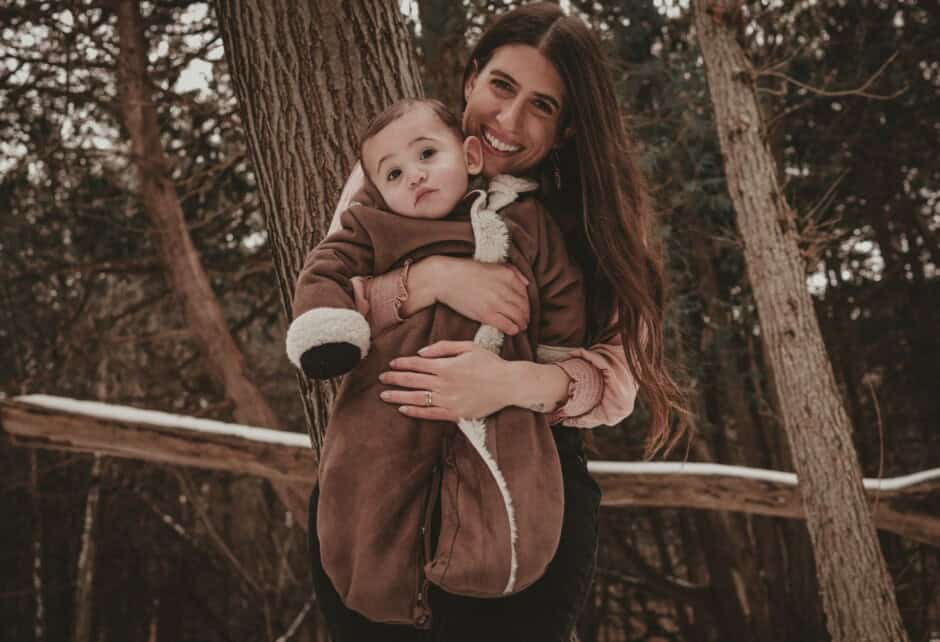
Bay Area mom Katie Caradec thought she had motherhood mapped out—education, career, a carefully timed baby, a neutral nursery waiting. But when her son’s needs began to challenge every expectation, the plan unraveled. In this deeply personal essay, the designer behind Good Little Things writes about neurodiversity, identity, and the quiet, radical practice of building a home—and a life—that truly fits.
I was like you: college educated, career driven, and climbing that ladder. I waited to get married and waited longer to have a child. It was a planned pregnancy, and the nursery was at the ready, decorated in gender-neutral grey and yellow. We were ready to live this dream called family, according to our shared vision. We were excited, but grounded, and couldn’t wait to meet our baby. I believed I knew who I was and how motherhood would unfold.
That certainty didn’t last—it shattered and laid us bare. Our plan could no longer meet the basic promises it was built on: predictability, stability, the ability to meet expectations. The life we had created no longer worked for our family. Our lived experience looked nothing like what we had imagined. We were left to forge a new path: one shaped by listening and acceptance, trial and error, and getting it wrong most of the time. This journey through motherhood wouldn’t just change my life. It would reveal parts of myself I’d never learned how to name, and eventually lead us toward understanding our neurodiversity.
I had always been creative. As a child, I expressed myself through drawing and painting, bike riding and tree climbing. I was constantly moving and on the go. In college, I studied architecture as a loophole—a way to have a career and still stay creative. The education was more conceptual than practical, a degree in three-dimensional problem solving. I learned that my brain worked like spatial origami, folding and unfolding maps in my head, visualizing how three dimensions could become two. Finding architecture was like finding a couture dress for my brain. Things finally fit.
I met Andre in his living room, at a house party thrown in honor of a mutual friend. The house was eclectic and warm, with a sense of ease that made everyone feel welcome. There were hand-built speakers made from wood that once aged French brandy and a milled screen used as a room divider between the entry and living room. A week later, we went on our first date. By the third, I knew. By all accounts it happened fast, although it never felt that way. It unfolded in its own way, when the timing was right and things just effortlessly fit together.
My son was born two weeks late on the first day of July 2014, almost exactly three years after we exchanged vows. I had to be induced; there was no movement on his behalf. I was sure he would stay in there his whole life if given the chance. When he arrived, after only forty-five minutes of pushing, he slithered out of me, like a snake crawling out of its skin.
He was a wild being from the start. He loved movement. We spent hours bouncing him on large physio balls, the harder and higher we bounced, the more he was soothed. He refused to breastfeed; when he came close to the breast, he would turn rigid, flush red, and scream. He cried inconsolably if placed in a bassinet to sleep, so for months he slept in a bouncy chair powered by D batteries, vibrating his tiny, swaddled body all night.
In preschool during circle time, the children sat on the carpet and listened to a book. He ran around the outside of the circle, as if he were playing duck-duck-goose, only by himself. We signed him up for soccer, but he wouldn’t participate. He stood apart from the other children, looking on with skepticism and giving a strong side-eye to the instructor.
And yet, my son loved playdates and being with friends. We spent long afternoons at the park, where he could swing for hours. Eventually—and out of sheer necessity—I taught him how to pump the swing himself. Delighted by the new skill, he propelled himself back and forth, higher and higher. He loved to ride his bicycle, climb to the highest points of the play structure, and explore his surroundings. He was endlessly curious about the world and how it worked.
With the start of kindergarten and compulsory education, things began to feel different. Getting him dressed, fed, and out the door became a daily struggle. At school drop-off, he would run away from us or refuse to go into the classroom altogether. We eventually worked with his kindergarten teacher to create a different drop-off routine, one that took place away from the other students. Over time, we learned that the classroom aide, who was meant to support special education students, spent much of the day with him, helping him stay focused and on track with classroom work.
During COVID, we experienced the challenges of teaching my son at home. When I asked him to complete a few math problems, he would fall to the ground, writhing, clutching his stomach, and crying as if he were in pain. Standing above him, with the math problems spread across the table and my child on the floor below me, I knew this wasn’t typical. I didn’t yet know what was different, or whether there was a name for it, but I knew we could no longer pretend that our home life was normal. We were struggling to hold things together. I don’t know what the opposite of thriving is, but that’s where we were during those isolating months of sheltering in place.
He received a diagnosis of ADHD at the age of six. We pursued all of the recommended supports: occupational therapy, speech and language therapy, and traditional talk therapy. We trialed a stimulant medication to help him attend school, complete tasks, and learn. Andre and I took parenting classes and received one-on-one coaching. We implemented reward systems designed to modify his behavior—strategies recommended by the psychologists, psychiatrists, pediatricians, and parent coaches we turned to for guidance.
Despite this, we saw little progress. Instead, a consistent pattern of school refusal continued to unfold before us.
It wasn’t until the fall of 2023, during a parenting class Andre and I were taking, that we encountered information that gave shape to our experience—a missing piece that finally brought things into focus. During one session, a fellow parent mentioned a profile of autism called Pathological Demand Avoidance (PDA). After class, I looked it up. I was immediately curious. I read everything I could find, ordering several books online when I realized they weren’t available through our local library. The descriptions felt uncannily familiar, as if the books were describing my child—as if they knew my child.
He was diagnosed with Autism Spectrum Disorder (ASD) in the spring of 2024, and while the assessment report describes his atypical presentation, it does not specifically mention Pathological Demand Avoidance, as it is not formally recognized in the DSM-5 in the United States.
Since receiving the diagnosis, we have made different decisions—many of them outside mainstream parenting approaches or standard recommendations for children on the spectrum. These decisions are rarely clear-cut. We are constantly navigating as we go, trying things out and pivoting as needed.
This journey has required an incredible amount of acceptance and personal work—learning to see myself clearly and to acknowledge my own limitations. As I have learned about my son and how his brain works, it has also meant exploring my own wiring and sensitivities. At the age of forty-two, I was diagnosed with ADHD. Looking back, I can now see those traits clearly in my childhood: never able to sit still, always on the go, struggling to stay focused and easily distracted. Now that he has an ASD diagnosis, I am also exploring whether I, too, may be on the spectrum.
The family life we have created looks very different from what I once envisioned. I am no longer a career woman. I am a neurodiverse designer who believes in process over perfection and understands that plans must evolve to meet the needs of a complex family system. I collaborate with families to create homes that work for them, knowing that small changes can have a big impact—and that embracing our authentic selves allows for environments rooted in acceptance, belonging, and peace, however each family defines it. This life is rarely linear or executed according to plan. Having a home that can pivot with the needs of your family is essential to everyone’s wellbeing.
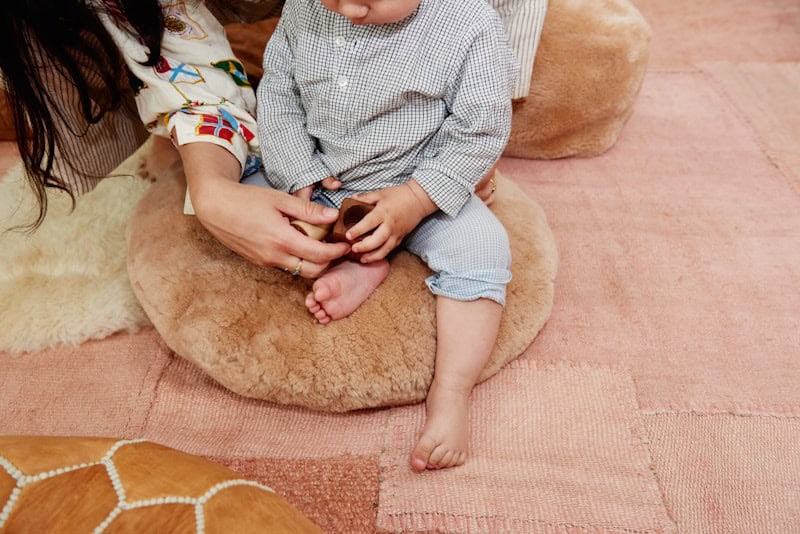
In those early days of our family journey, just months before the COVID shelter-in-place mandate, I decided to rethink our kitchen nook. We never ate at the kitchen table. It had become a repository for toys, mail, and junk, so I sold it. I let the space remain empty for a while, pausing to observe how our family actually used it. Slowly and with intention, I began adding things back: a cozy, sweater-like rug for playing on the floor with my son, a few plants to soften the hard lines, and antique rocking chairs I found in the basement. None of the changes were large, and none cost much money.
But something unexpected—almost magical—happened.
The open, interpretive space became our family room—a place where we gather, connect, and breathe. This wasn’t the plan when I started. But by staying open to the process, accepting what was, and holding space for possibility, we found our way. We created a family room that supports our current life and our neurodiverse wiring.
This journey through motherhood is one I could never have anticipated. It has changed my life and revealed parts of myself I’d never learned how to name. Motherhood didn’t give me clarity or a new plan. It taught me how to practice acceptance and to listen—to my child, to myself, and to the spaces we live in together.
Katie Caradec is a designer and mother based in the San Francisco Bay Area. She is the founder of Good Little Things, a design studio rooted in the belief that homes should support real life and evolve alongside the families who live in them.
Share this story